 how-to
How to Wrap a Burrito Like a Pro
Table of Contents
- Why Wrapping Technique Matters for Your Burrito
- How to Warm Tortillas for Burritos
- How Much Filling to Put in a Burrito
- How to Fold a Burrito Step by Step
- How to Keep a Burrito from Falling Apart
- Common Mistakes to Avoid When Wrapping
- Pro Tips for Wrapping Large Burritos
- Frequently Asked Questions
Last Updated: October 13, 2026
Why Wrapping Technique Matters for Your Burrito
A great burrito starts before you take the first bite. The way you wrap a burrito determines whether it holds together or falls apart the moment you pick it up.
Most people underestimate how much technique matters. They pile on filling, fold hastily, and end up with a burrito that leaks or tears.
When you wrap a burrito correctly, the tortilla becomes flexible and forgiving. You can pack real flavor without worrying about it spilling everywhere. You'll handle it confidently. You'll taste everything you paid for.
Here's what separates a properly wrapped burrito from a sloppy one: the tortilla needs heat, the filling needs balance, and your hands need to follow a specific sequence.
How to Warm Tortillas for Burritos
A cold tortilla cracks. A warm one bends.
This is the single most important step most home cooks skip. You cannot wrap a burrito successfully with a tortilla straight from the package. It will tear. It will split. You'll end up frustrated.
Warming your tortilla makes it pliable and strong. Heat opens up the flour structure and releases moisture that keeps the tortilla flexible. A warm tortilla can fold tight without breaking.
Three ways to warm tortillas:
- Stovetop (fastest): Heat a cast-iron skillet or griddle over medium-high heat. Place the tortilla directly on the hot surface for about 20-30 seconds per side. You'll see it puff slightly and develop light brown spots. Flip and repeat.
- Open flame (if you have gas): Hold the tortilla with tongs about 2 inches above the flame for 10-15 seconds per side. Rotate it so all edges get heat. This method creates the most flexible tortilla.
- Microwave (easiest for groups): Wrap tortillas in a damp paper towel and microwave for 30-45 seconds. Check one to make sure it's warm throughout. This keeps them warm longer than stovetop.
The key is not to overheat. You want warmth, not charring. A tortilla that's too hot becomes brittle. A tortilla that's just warm enough becomes a perfect wrapper.
Testing Tortilla Flexibility
Before you start filling, test your tortilla. Gently fold it in half. If it creases without cracking, you're ready. If it resists or shows white cracks, it needs more heat.
A properly warmed tortilla feels soft and slightly steamy. It should bend without stiffness. When you hold it, it should feel alive in your hands, not stiff like cardboard.
If your tortilla cracks even after warming, you have two options: microwave it again for 15 seconds, or grab a fresh one and rewarm it. Don't fight a cracked tortilla. You'll lose.
How Much Filling to Put in a Burrito
This is where most people go wrong. They see a big tortilla and think they need to fill every inch.
You don't. Overfilling is the #1 reason burritos fall apart, and it fails for a mechanical reason: the tortilla only has so much slack. Every fold consumes surface area.
A useful starting point is about 3/4 cup of total filling for a standard 10-inch flour tortilla.
Scale filling to tortilla size:
- 8-inch (taco size): about 1/2 cup. Best for small, single-protein burritos.
- 10-inch (standard): about 3/4 cup. The everyday workhorse.
- 12-inch (large): about 1 to 1 1/4 cups, not more. The extra surface area is for folding, not for stuffing.
The filling zone:
- Leave about 1 inch of space on the top and bottom edges
- Leave about 1.5 inches on the left and right sides
- Mound your filling in the center, creating a rough line about 2 inches wide and 5 inches long
- Keep the mound about 1 inch tall
That footprint leaves you a border of bare tortilla on all four sides, which is exactly the material you need to fold and roll without tearing.
Balance the filling types. A burrito is a structure, and different fillings behave differently inside it:
- Dense and dry (meat, beans, rice): These hold shape and add bulk. They are the backbone. Aim for roughly two-thirds of your total volume from this group.
- Creamy (sour cream, guacamole, crema): These add moisture and slip. Too much and the filling slides out of the roll. Keep them to a thin layer, about 1 to 2 tablespoons.
- Wet (salsa, pico de gallo, hot sauce): These soak the tortilla and weaken it. Use them sparingly inside, or add them after wrapping, on top or on the side.
Why less filling tastes better, not worse. A burrito that holds together lets you taste every layer in every bite. A burrito that bursts dumps its contents onto the plate on the first bite. The goal is a balanced ratio of tortilla to filling, not maximum volume. Most practitioners find that a properly wrapped 3/4-cup burrito feels more satisfying than an overstuffed one that falls apart halfway through.
How to Fold a Burrito Step by Step
This is the technique that separates a pro wrap from an amateur one. Follow these steps exactly, and your burrito will hold.
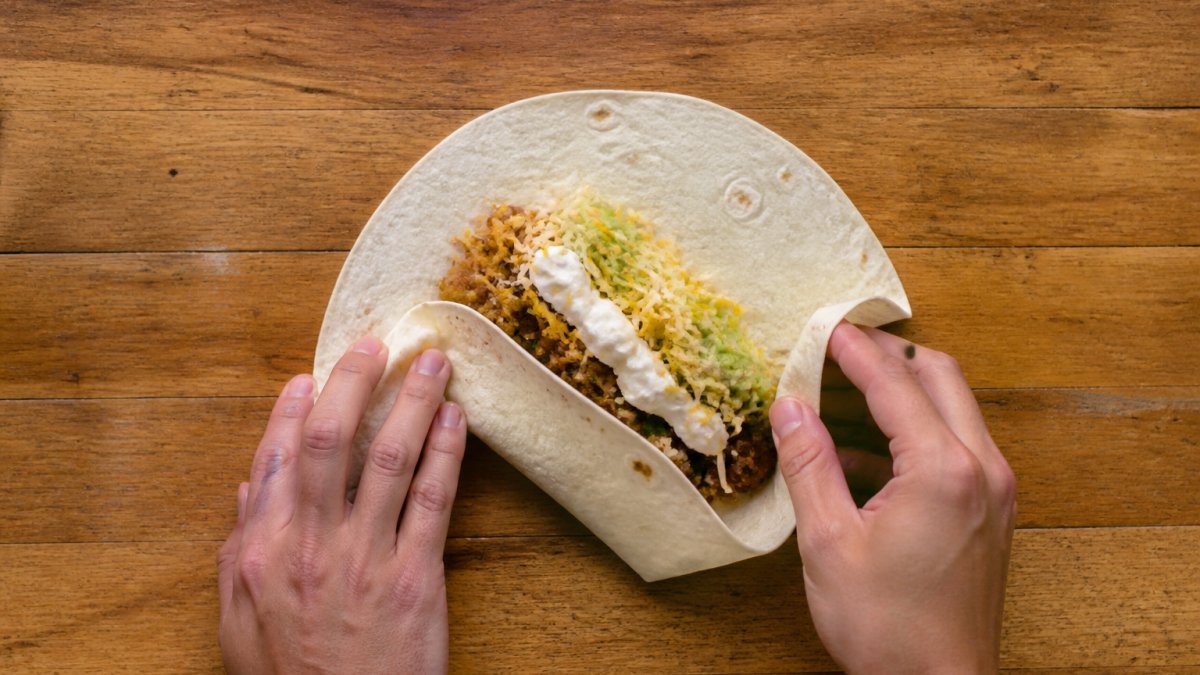
Step 1: Position Your Tortilla and Filling
Place your warm tortilla on a clean, flat work surface. Position it so it looks like a diamond, one corner pointing toward you.
Now add your filling. Create a horizontal line of filling about 2 inches from the bottom edge. Keep it centered. Don't spread it edge to edge. Remember: you need folding room.
Your filling should be about 1 inch tall. This is the sweet spot for balance.
Step 2: Fold the Bottom and Sides
This is where the wrap a burrito technique really begins.
Fold the bottom corner of the tortilla up and over the filling. Pull it tight toward you. You're creating tension. This tension keeps everything locked in place.
Now fold the left corner toward the center. Tuck it under the filling. You should see the filling getting tighter.
Fold the right corner toward the center. Tuck it under the filling too. You now have a burrito shape that looks like an envelope.
The key here is tension. Pull gently but firmly. Don't be timid. The tortilla is warm and forgiving.
Step 3: Roll Tightly Toward the Top
This is the final move that determines whether your burrito stays together.
Starting from the bottom (the side closest to you), roll the burrito toward the top. Keep it tight. Roll slowly and deliberately. You're not rushing this.
As you roll, tuck the filling back into the burrito with your fingers. If you feel filling trying to escape, stop, tuck it, and keep rolling.
When you reach the top corner, fold it down and tuck it underneath. The seam should be on the bottom. This is your final lock.
How to Keep a Burrito from Falling Apart
Once you've wrapped your burrito, it needs to stay wrapped.
The biggest mistake is moving it too soon. Let it sit for 30 seconds after wrapping. The warmth of the filling helps set the tortilla. The seam fuses slightly.
When you pick it up, support it from underneath. Don't grab it like a sandwich. Cup it in both hands. Let the seam stay on the bottom where it's protected.
If you're wrapping burritos ahead of time, wrap them in foil. This keeps them warm and holds them together. Unwrap just before eating.
For burritos that need to travel, wrap them in foil and then in a paper bag. The foil keeps heat in and holds structure. The paper bag keeps everything from sliding around.
Common Mistakes to Avoid When Wrapping
Mistake 1: Using a cold tortilla. This is the biggest one. A cold tortilla will crack and tear. Always warm your tortilla first.
Mistake 2: Overfilling. More filling doesn't mean a better burrito. It means a burrito that falls apart. Stick to 3/4 cup.
Mistake 3: Loose folding. Tension matters. When you fold and roll, pull firmly. You're creating structure, not gently placing filling.
Mistake 4: Wet fillings. Salsa, excessive sour cream, and wet ingredients make the tortilla soggy. Use them sparingly or add them after wrapping.
Mistake 5: Forgetting the bottom fold. Many people skip the initial fold of the bottom corner. This is critical.
Mistake 6: Putting the seam on top. The seam should always be on the bottom.
Pro Tips for Wrapping Large Burritos
Large burritos need special attention.
Match the tortilla to the job. A 12-inch flour tortilla is the practical ceiling for a hand-held burrito.
Reduce filling density, not just volume. Counterintuitively, a large burrito should carry less filling per inch than a standard one.
Warm it longer and test it. A larger tortilla needs more heat to become fully flexible.
Use the envelope fold for big burritos. For large burritos, fold all four sides inward before rolling, rather than only the bottom and two sides.
Wrap in foil immediately. Large burritos benefit from foil wrapping right after you finish.
Troubleshooting Large-Burrito Failures
Even with good technique, big burritos fail in predictable ways. Here is how to diagnose and fix each one:
- Torn tortilla at the seam: Usually caused by overfilling or a tortilla that was not warm enough. Remove some filling, and if the tear is small, patch it with a second small piece of warmed tortilla pressed over the seam.
- Loose, gaping ends: The side folds were not tucked under the filling. Reopen the burrito, tuck the left and right corners firmly under the mound, then re-roll.
- Leaking filling during the roll: Wet ingredients are escaping. Stop, tuck the filling back with your fingers, and consider moving wet elements to the top or side after wrapping.
- Burrito that sags in the middle: The tortilla is too thin for the load. Add a second tortilla as a liner or reduce filling.
- Seam that pops open after wrapping: The roll was not tight enough. Re-roll with firmer, more consistent tension, and let the burrito rest seam-side down for 30 seconds so the warmth helps it set.
Frequently Asked Questions
Should you warm a tortilla before wrapping a burrito?
Yes, warming your tortilla is essential. A warm tortilla becomes flexible and pliable, making it much easier to fold without cracking. Cold tortillas are brittle and will tear or split when you try to wrap them. Warm tortillas on a skillet, griddle, or over an open flame for 10-15 seconds per side until they're soft and steaming. This simple step makes the difference between a burrito that holds together and one that falls apart.
How much filling should you put in a burrito?
Fill your burrito about one-third to one-half full, leaving at least 1.5 inches of empty space on all sides of the tortilla. This space is crucial for folding and sealing. Overfilled burritos burst open when you roll them and are difficult to eat. Start with less filling than you think you need, then add more once you've mastered the folding technique. A well-proportioned burrito is easier to wrap, more stable, and more enjoyable to eat.
How do you keep a burrito from unrolling?
Keep your burrito from unrolling by rolling it tightly and tucking the filling as you go. Start by folding the bottom edge up and over the filling, then fold both sides inward at sharp angles. Roll the burrito away from you with steady, firm pressure, tucking the ingredients in as you move. The key is tension, don't roll loosely. Serve the burrito seam-side down so gravity helps hold it closed. If wrapping ahead of time, wrap it tightly in foil or parchment paper to maintain its shape.
What's the difference between wrapping a large burrito and a standard one?
Large burritos require a bigger flour tortilla and careful filling distribution to avoid overstuffing. Use a 12-inch or larger tortilla instead of the standard 10-inch. Divide your filling into sections, proteins on one half, vegetables and sauces on the other, so weight distributes evenly. Roll more slowly and deliberately, applying consistent pressure throughout. Large burritos are heavier and more prone to tearing, so ensure your tortilla is perfectly warm and your technique is controlled. Practice with standard sizes first before attempting massive burritos.